Most people never give their power points a second thought, right up until one starts to buzz, discolour, or feel warm to the touch. The trouble is that electrical faults are one of the leading causes of house fires in Australia, and they often begin in exactly the place you would least expect: a tired old outlet or an overloaded power board behind the lounge.
At Power Amp Electrical, we install and repair power points across Melbourne's western suburbs and Geelong every week, and we see the early warning signs long before most homeowners do. Here is what actually causes a power point to catch fire, the signs you should never ignore, and the simple steps that keep your home safe.
How a Power Point Actually Catches Fire
A power point does not burst into flames on its own. A fire almost always comes down to heat building up where it should not, usually from one of these causes:
- Loose or worn connections. Over years of use, the contacts inside an outlet loosen. Every loose connection creates resistance, resistance creates heat, and that heat builds up slowly inside the wall cavity where you cannot see it.
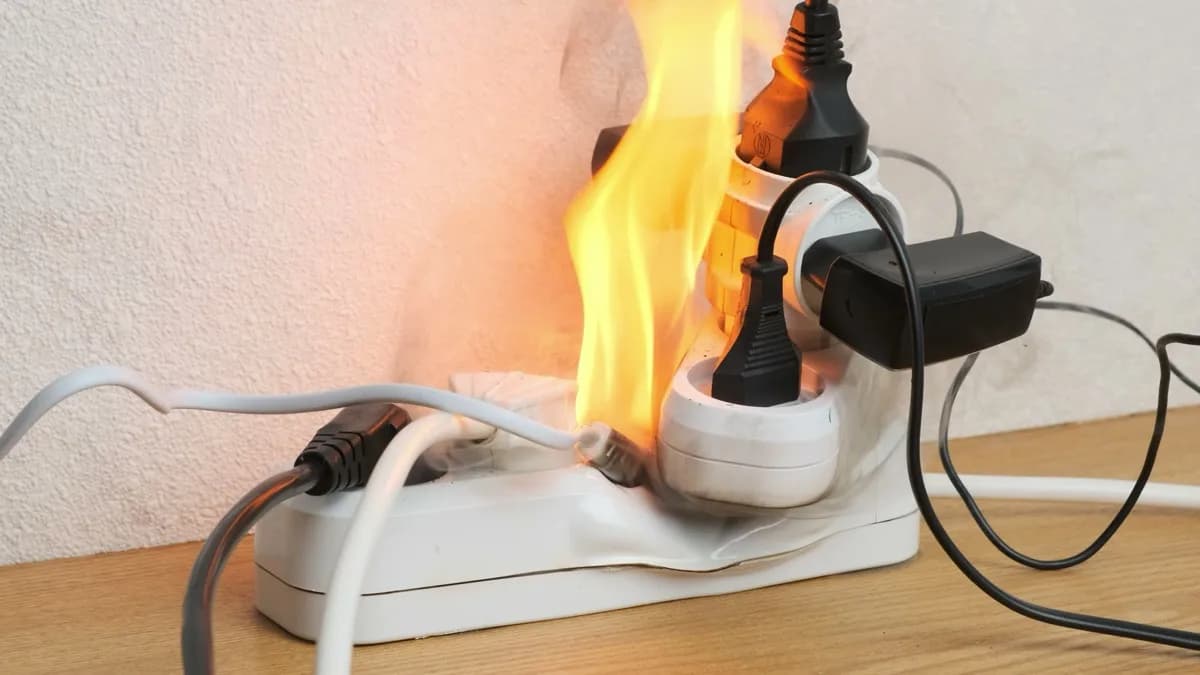
- Overloaded outlets and power boards. Double adapters stacked on double adapters, or a power board running a heater, a dryer and three other appliances, can draw far more current than the circuit was designed for. The outlet overheats, the plastic softens, and eventually it ignites.
- Cheap or damaged accessories. Unbranded power boards and travel adapters often use thin internal wiring and poor contacts that simply cannot handle Australian loads safely.
- Ageing wiring. In older homes, deteriorating cable insulation and undersized wiring struggle with modern appliances, and the weakest point, often a power point, is where the heat shows up first.
- Moisture. Water near outdoor or bathroom outlets can cause arcing and short circuits.
The frightening part is that this damage develops behind the wall. By the time you smell burning, the fault has usually been building for weeks or months.
Warning Signs You Should Never Ignore
If you notice any of the following, stop using the outlet and book a licensed electrician. These are the signs we treat as urgent:
- The power point feels warm or hot to the touch, even with nothing heavy plugged in.
- Scorch marks, browning or discolouration around the outlet or on the wall.
- A burning, fishy or melting-plastic smell near an outlet or your switchboard.
- Buzzing, crackling or sizzling sounds coming from the wall or the power point.
- Sparks when you plug in or unplug an appliance (a small spark on a high-draw appliance can be normal, repeated or large sparks are not).
- Plugs that fall out easily or feel loose in the socket, a sign the internal contacts are worn.
- A safety switch that keeps tripping when you use a particular outlet.
A single warm power point might seem minor. It is not. It is the clearest early warning you will get that something behind the wall is overheating.
The Double Adapter and Power Board Trap
The most common cause of outlet fires we see in family homes is simple overloading. Australian homes are using more power than ever, but the number of power points in older houses has not kept up. The result is double adapters piggybacked together and power boards running high-draw appliances they were never meant to handle.
A few rules that genuinely prevent fires:
- Never plug one power board into another, and never stack double adapters.
- Keep high-draw appliances (heaters, dryers, kettles, air conditioners) on their own wall outlet, not a power board.
- Use power boards with built-in overload protection, and replace any that feel warm.
- If you are constantly reaching for power boards, that is the sign you need more power points installed, not another adapter.
Adding a few extra outlets is a small, affordable job that removes the single most common cause of outlet fires for good.
Your Safety Switch Is Your Last Line of Defence
Modern homes are protected by safety switches (RCDs) in the switchboard. These devices cut the power in a fraction of a second when they detect a fault, which can be the difference between a tripped circuit and a fire or a fatal shock.
The problem is that many older homes in Melbourne's west still run on switchboards with ceramic fuses and no RCDs at all. If your switchboard has not been touched in decades, a faulty outlet has nothing standing between it and disaster. This is exactly why a switchboard upgrade with RCD protection on every circuit is one of the best safety investments you can make. If you are not sure what protection you currently have, our 7 warning signs you need a switchboard upgrade is a good place to start.
What to Do If You Suspect a Faulty Power Point
If a power point is warm, sparking, discoloured or smells of burning:
- Stop using it. Unplug whatever is connected, if you can do so safely.
- Switch off the circuit at the switchboard, or the main switch if you are unsure which circuit it is.
- Do not try to open the outlet yourself. There is no safe DIY fix for a power point.
- Call a licensed electrician. If there is smoke, a persistent burning smell, or any sign of fire, treat it as an electrical emergency and call us, or 000 if there is an immediate danger.
A faulty outlet caught early is usually a quick, inexpensive repair. Left alone, it is a genuine fire risk.
How to Keep Your Power Points Safe
Prevention is straightforward and far cheaper than the alternative:
- Have an electrical safety inspection if your home is more than 20 years old, or if you have just bought it.
- Replace any power point that is cracked, loose, discoloured or warm.
- Add extra outlets instead of relying on double adapters and power boards.
- Make sure every circuit is protected by a working safety switch.
- Book a switchboard assessment if you still have ceramic fuses or no RCDs.
For more everyday habits that keep your home safe, see our guide to electrical safety tips for Melbourne homes.
Frequently Asked Questions
Is it normal for a power point to feel warm?
No. A power point should stay at room temperature. Warmth, even slight, points to a loose connection or an overloaded circuit and should be checked by a licensed electrician promptly.
Can an overloaded power board really start a fire?
Yes. Overloading is one of the most common causes of outlet fires we see. Power boards and double adapters draw all their current through one wall outlet, and stacking them or running high-draw appliances through them can overheat the outlet until it ignites.
Why does my power point spark when I plug something in?
A tiny spark when connecting a high-draw appliance can be normal. Repeated, large or bright sparks, or sparks with a buzzing sound, indicate worn contacts or a wiring fault and need to be inspected straight away.
Will a safety switch stop a power point fire?
A safety switch (RCD) dramatically reduces the risk by cutting power the instant it detects a fault, but it is not a substitute for fixing worn outlets and avoiding overloads. The best protection is RCDs on every circuit combined with sound, well-maintained power points.
Book a Power Point Safety Check
If a power point in your home is warm, sparking, discoloured or buzzing, do not wait. We carry out power point repairs, outlet upgrades and full safety inspections across Western Melbourne and Geelong.
📞 Call Josh on 1300 797 267
Power Amp Electrical is a licensed electrical contractor (REC-34500) serving Western Melbourne and Geelong. All work complies with AS/NZS 3000 and includes a Certificate of Electrical Safety.